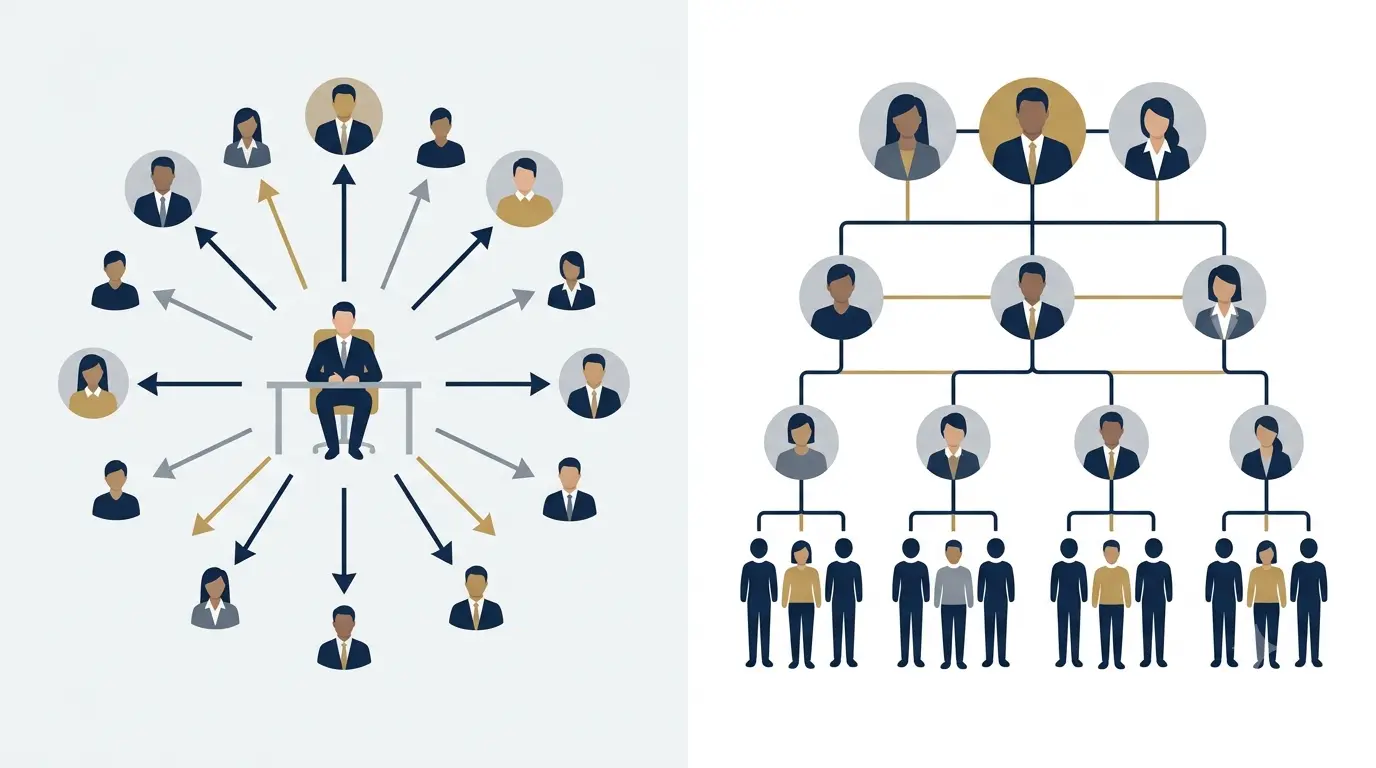
An owner-led business is one where the founder or promoter personally makes most operational, financial, and hiring decisions; a professionally managed business is one where documented systems, delegated authority, and non-family managers run day-to-day operations while the owner focuses on governance and strategy.
The distinction sounds semantic, but structurally the two are very different organisations, with different failure modes, growth ceilings, and valuation multiples. This piece breaks down what actually changes when a business moves from one model to the other, why the shift is disproportionately important in India, and how owner-led SMEs can start the transition without losing what made them successful.
Why this matters in India specifically
Family and owner-led businesses aren’t a niche in the Indian economy, they are the economy. India has roughly 5 million family businesses contributing around 70% of national GDP, and other analyses put family-business contribution as high as 79% when broader private ownership is included (CEO Worldwide, citing CMIE).
The survival numbers, however, are sobering. Research aggregated by multiple Indian consulting studies shows that only about 30% of family businesses survive to the second generation, 12% reach the third, and just 3% make it to the fourth. Even more striking: only 15–21% of Indian family businesses have documented succession plans.
The single biggest predictor of which side of that survival statistic a business ends up on is not sector, capital, or even generational talent, it’s whether the business made the structural shift from owner-led to professionally managed before crisis forced it to.
What structurally changes: a side-by-side comparison
The clearest way to understand the difference is to look at how a specific decision, say, approving a ₹8 lakh capital expense, or hiring a mid-level manager, actually flows through the two structures.
Decision-making authority
In an owner-led business, decisions of any material size route to the founder. This is fast for small teams and creates a strong quality bar in the early years, but it becomes a bottleneck once the business crosses roughly 25–30 employees. The founder’s calendar becomes the throughput ceiling of the entire company.
In a professionally managed business, decisions are pushed down to defined authority levels. Typical Indian professionalised SMEs reserve founder sign-off for a narrow set, usually capex above a threshold (₹5 crore in larger firms, ₹25–50 lakh in mid-sized ones), C-suite hires, major acquisitions, and dividend policy, and delegate everything else.
Financial visibility
Owner-led businesses commonly commingle personal and business finances, run informal cash controls, and rely on the founder’s mental model of what the business is worth. Even profitable firms in this mode often can’t produce a clean three-year P&L on demand, which shows up painfully when they try to raise debt, sell, or bring in equity partners.
Professionalised firms separate personal and business finances, run monthly closes, and produce audit-ready statements. The direct effect is measurable: analyses of Indian family-business professionalisation report 10–15% EBITDA improvement and 20–30% productivity gains within 18 months of structural professionalisation, driven mostly by working-capital and process gains rather than revenue growth.
Talent depth and retention
Owner-led businesses tend to have a strong founder plus a thin middle layer of long-tenured loyalists. Talent doesn’t leave, but it also doesn’t grow, because growth requires taking real ownership, and real ownership requires the founder to actually let go. Ambitious mid-career hires tend to leave within 12–18 months when they discover the ceiling.
Professionally managed firms build a real second line. Compensation is benchmarked to market, performance management applies uniformly (including to family members), and there is a defined career path beyond “become the founder’s shadow.”
Founder dependency, the litmus test
A useful diagnostic used by Indian family-business consultants is what Crescentia Strategists calls the three-month sabbatical test: can the business function effectively if the founder takes a three-month sabbatical with no communication? If the honest answer is no, professionalisation is no longer optional, it’s a business-continuity issue.
The middle stage nobody talks about
Most SME owners assume the shift from owner-led to professionally managed is a single decision, hire a COO, delegate, done. In practice, the Indian School of Business’s research on Indian family firms describes an intermediate zone the researchers call a “No Man’s Land”, a period where roles between the family leader and the professional manager are ambiguous, decision rights overlap, and the professional hire often burns out or is quietly pushed out within 12–18 months.
This middle stage is where most Indian SME professionalisation attempts fail. The founder brings in a senior professional, hands over a title but not real authority, and then intervenes in every meaningful decision. The professional either leaves or learns to work around the founder, at which point the organisation is worse off than before, because it now has the cost of professional management without the benefits.
Avoiding this trap requires writing down, before the hire, exactly which decisions the founder retains, which the professional owns, and what the review cadence is. It’s an uncomfortable conversation, but every family business that has professionalised successfully has had it.
What professionalisation is not
A few common misconceptions worth clearing up, because they cause otherwise-willing owners to stall:
- Professionalisation is not replacing family with outsiders. Family members can and often should hold operational roles, the shift is toward defined roles with measurable KPIs, not toward the exit of family.
- It is not adopting corporate rigidity. SMEs don’t need Fortune 500 committees; they need clarity on who decides what, and documented processes that survive one person’s absence.
- It is not primarily a hiring problem. Bringing in one senior professional does not professionalise a business, it usually just puts a professional inside a still-founder-dependent structure.
The clearest framing comes from Stratisian’s work on Indian family businesses: professionalisation is the shift from family-run (where family members manage everything) to family-owned (where family provides governance while professionals, including family members with defined roles, manage operations).
A practical starting sequence for owner-led SMEs
For a business currently in the ₹5–50 crore revenue range that wants to start the transition without disrupting operations, the sequence that consistently works is:
- Document the top 20 processes. Not everything, just the 20 that, if the founder disappeared for a month, would collapse. Sales pipeline, cash flow, hiring, vendor payments, customer complaints, monthly close. Most owner-led businesses have zero of these written down.
- Separate personal and business finances. Distinct bank accounts, board-declared owner remuneration replacing ad-hoc drawings, and monthly financial statements, even if the business is profitable and comfortable, this is the single highest-leverage cleanup.
- Build a delegation matrix. A single-page document listing every recurring decision type and who owns it. Force yourself to move at least 40% of your current daily decisions to someone else, with a clear escalation trigger.
- Hire the second line, then the C-suite. Counter-intuitively, most Indian SMEs try to hire a CEO or COO first. The higher-leverage move is to build a strong layer of function heads (Head of Sales, Head of Operations, Head of Finance) that a future professional CEO can actually work through.
- Institute a monthly management review. A structured 90-minute meeting with a fixed agenda: financials, top 3 risks, top 3 opportunities, key hires, and decisions requiring founder input. This single meeting, done consistently for 12 months, does more for professionalisation than most external interventions.
When to bring in outside help
Not every owner-led business needs a consultant to make this transition, some founders and family teams professionalise entirely on their own over a five-to-seven-year horizon. Outside help earns its cost in three specific situations:
- Succession or generational transition is 24–36 months away and no plan exists.
- The founder has already tried to delegate and it has failed twice or more, usually a signal that the underlying structure, not the individual hires, is the problem.
- A specific event (fundraising, acquisition, family exit, or entry of next generation) is forcing a formal governance structure onto a business that has never had one.
In each of these cases, an experienced third party earns their fee by naming the uncomfortable trade-offs the family has been avoiding, and by holding the structure in place during the messy transition period when the founder’s instinct is to reassert control.
The honest bottom line
Owner-led businesses aren’t worse than professionally managed ones, they are optimised for different things. Owner-led firms are faster, more culturally consistent, and better at survival in the first decade. Professionally managed firms are more scalable, more sellable, and more likely to survive a leadership change.
The mistake is not choosing one or the other. The mistake is drifting into a mid-stage where the business has outgrown owner-led decision-making but hasn’t yet built the structures of professional management, and staying stuck there. Every year in that middle zone compounds into lost talent, foregone growth, and eventually a succession event the business isn’t structurally ready for.
If you’re an owner-led business already thinking about this transition, the best time to start was three years ago. The second-best time is before the transition is forced on you.
Frequently asked questions
Is an owner-led business the same as a family business?
Not exactly. All family businesses are owner-led when the founder or a family member personally runs operations, but not all owner-led businesses are family businesses, a solo founder without family involvement is also owner-led. The structural challenges of professionalisation are similar in both cases.
At what revenue does an owner-led business typically need to professionalise?
There is no fixed threshold, but the pressure typically becomes acute somewhere between ₹5 crore and ₹25 crore in revenue, or when headcount crosses 25–30 employees. Businesses that professionalise before this window usually find the transition much smoother than those that wait until crisis forces it.
Can a family member be a “professional manager”?
Yes. Professionalisation is about role clarity, defined authority, and measurable performance, not about the manager’s surname. A family member operating under a documented role definition, market-benchmarked compensation, and the same performance management as everyone else is a professional manager.
How long does the transition typically take?
For a mid-sized Indian SME, a realistic timeline is 18–36 months from serious commitment to a fully professionalised operating rhythm. Founders who expect it to take 6 months almost always create the “No Man’s Land” failure pattern by pushing changes faster than the organisation can absorb them.
What is the single highest-leverage first step?
Documenting the top 20 processes that keep the business running, and then separating personal and business finances. These two actions together typically reveal how founder-dependent the business actually is, and give the founder concrete places to start delegating.

Co-founder of SutraSarthi. A decade building scalable HR and startup systems across manufacturing, renewable energy, FMCG and fintech.